 |
 |
 |
 |
 |
 |
 |
 |
 |
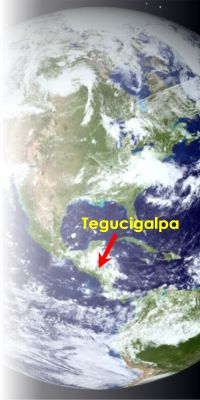
Republic of Honduras Area: 112,492km2 Population: 7,400,000 (2006) Capital: Tegucigalpa Language: Spanish Religion: Catholicism |
 |

Schools in Honduras focus on teaching arithmetic, algebra, geometry, trigonometry, and precalculus as part of the study plan.
|

Most universities in Honduras do not require an entrance examination. However, my university back home is a private university that requires its students to take a mathematics exam. The results from this exam determine whether you must take Mathematics Review Course which basically serves as reinforcement for those topics taught in high school.
|

I am not really aware of what the Mathematics content is in Japanese High Schools, so I feel unable to properly answer this question. Nonetheless, studying Mathematics as a career is not as popular in Honduras as it is in Japan, reason why I assume that perhaps the content might be stronger in Japan than in Honduras.
|

I think that the major problem would be a lack of interest in studying mathematics.
|

Mathematics is a part of every person's life. Be it calculating the total to pay at the supermarket or in even finding the best route to get home (timewise), math is involved. Although different situations require for different depths of theoretical mathematical knowledge, the ability to look at things logically and systematically is, in my opinion, useful in all aspects of life.
|

The Japanese Government assigned me to Hirosaki University. Since my major in my home university is not mathematics, at first I was very nervous about studying in Hirosaki University, but the kindness of my teachers and classmates have all been a key factor to make this a pleasurable experience for me.
|

|

|